Composite Deck Builders in The Colony, TX
Different Roofing is one of the composite deck builders in The Colony, TX that designs and builds low-maintenance composite decks for homes across Dallas–Fort Worth. A composite deck does not rot, splinter or need staining, so the deck you see on day one is the deck you still have years later, without a weekend of sanding and sealing every couple of summers.
Call (682) 400-6163 Text usText (682) 400-6163
Composite vs. Wood in the Texas Heat
Wood decks in DFW live a hard life. Months of direct sun dry the boards out, spring storms soak them, and the clay soil keeps the space under the deck damp. Pine and cedar look great when they are new, but without regular cleaning and stain they gray, cup and split, and nail heads start to pop.
Composite decking is made from wood fibers and plastic, and most boards today have a protective outer shell. That shell keeps out water and UV, so the boards do not rot, termites leave them alone, and the color holds up far longer than unstained wood in full sun. PVC decking goes a step further: it is all plastic with no wood fiber, so it is lighter and even more resistant to moisture, which makes it a good fit near pools and in shady, damp yards.
One honest tradeoff: darker composite boards get hot in direct July sun, just like a dark car seat. If your deck faces west with no shade, we will talk through lighter colors or a cover over part of it. Wood still costs less up front and stays cooler, and we build both; see wood decks, porches and deck repair.
Maintenance: What a Composite Deck Needs
Very little. Composite wood decking never needs sanding, staining or sealing. A rinse with the hose and a soft brush with soapy water a couple of times a year keeps it clean. Wipe up grease from the grill before it sits in the sun, keep leaves from piling up in the gaps so water can drain, and use a plastic shovel on the rare winter morning with ice. That is the whole maintenance plan.
Colors, Boards and Custom Inlays
Composite boards come in a wide range of colors, from light grays and tans to warm browns and dark tropical tones, with wood-grain textures pressed into the surface. Because the boards come in several colors, they can be laid in patterns that would be hard to keep sharp in wood. A picture-frame border runs a contrasting board around the edge of the deck to hide the cut ends. A breaker board splits a long deck into sections. And a custom inlay turns the floor into the centerpiece of the yard.
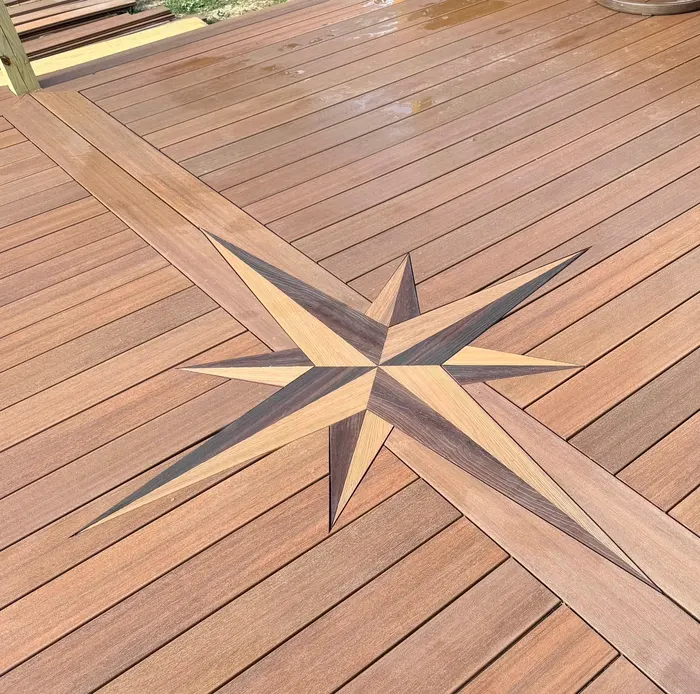
On North Colony Boulevard in The Colony, we built a composite deck with a wide border band and an eight-point compass star inlaid where the bands cross, cut from two contrasting colors and fitted tight into the field boards. It is the photo at the top of this page. Inlays like that take careful layout before the first board goes down, and extra framing under the cuts so every piece is supported.
Composite Deck Railings and Stairs
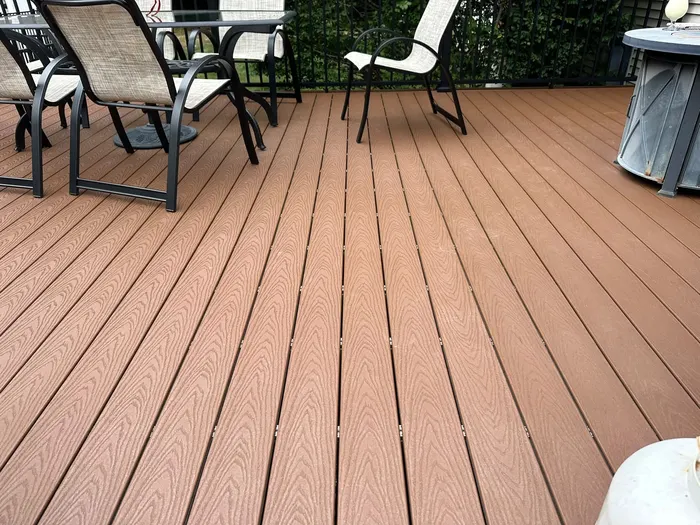
The railing changes the look of a composite deck as much as the boards do. On Eldorado Parkway in Little Elm, we built a composite deck in a warm brown tone with a black metal railing, which keeps the view into the backyard open and needs almost no upkeep. We also build composite deck railing to match the decking, and cedar or horizontal slat railings for a mixed look.
Stairs get the same composite treads and riser boards as the deck, set on properly spaced stringers so the treads stay flat and solid underfoot, with a handrail that matches the railing.
Covered Composite Decks
Adding a roof over all or part of a composite deck solves the heat problem and makes the deck usable from June through September. Because roofing is our main trade, we frame the cover on posts tied into the deck structure, roof it with shingles or metal to match your house, and can wire it for ceiling fans and lights. See patio covers for cover styles, or pergolas for open shade.
Built on a Solid Frame
Composite boards last a long time, so the frame under them has to last just as long. We set footings for the clay soil, frame with pressure-treated lumber, space the joists to what the board maker calls for, and use hidden fasteners so the surface stays clean with no screw heads. Where the deck attaches to the house, we flash the connection so water cannot get behind it and rot the wall. That is roofing-style detail work, and it is the part of a deck most likely to fail when it is skipped.
How a Composite Deck Job Runs
- Free estimate and design. We measure, talk through size, height, color, borders, railings and stairs, and give you a written estimate.
- HOA approval. If you have an HOA, we follow HOA rules and provide the plans and material details for your request.
- Footings and framing. Posts, beams and joists go in, set for the decking and the load the deck will carry.
- Decking, borders and inlays. Boards go down with the right gaps for drainage and expansion, and any borders or inlays are fitted.
- Railings, stairs and cleanup. We install railings and stairs, clean the site, and walk the finished deck with you.
What Drives Composite Deck Cost
Composite deck cost depends on the size and height of the deck, the board line and color you choose, composite versus PVC decking, the railing style, the number of stairs, custom borders or inlays, and whether you add a cover. We give you a free written estimate with those choices spelled out. Financing is available, as low as 0%. We are Licensed & Insured, and se habla español.
Areas we serve: The Colony, Little Elm, Frisco, Lewisville, Prosper, and all of North Texas.