- Home
- /
- Services
- /
- Commercial Roofing
- /
- Commercial Metal Roofing
Commercial Metal Roofing in Dallas–Fort Worth, TX
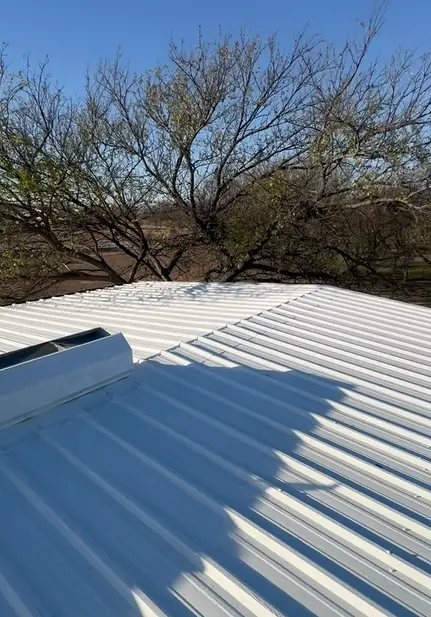
Drive any industrial park in Carrollton, Denton or south Dallas and most of the roofs you see are metal: R-panel and PBR panel roofs on warehouses, shops, self-storage and church multipurpose buildings, and corrugated metal on older sheds and canopies. Different Roofing installs, repairs, restores and retrofits these commercial metal roofs across Dallas–Fort Worth. Every job starts with a free inspection and a straight answer about whether your roof needs new panels or just the right repair.
Call (682) 400-6163 Text usText (682) 400-6163
R-Panel and PBR Panel Roofing
R-panel and PBR panel look almost the same from the ground. Both are exposed-fastener steel panels, usually 36 inches wide, with tall major ribs every 12 inches and smaller ribs between them, and both come in 26 and 29 gauge in a wide range of colors. The difference is at the side lap where two panels overlap. PBR stands for purlin bearing rib: the panel has an extra leg on its edge that rests on the purlin, so the overlap is supported instead of hanging in the air. That makes PBR the stronger, better-sealing choice for roofs on metal buildings with purlins. R panel roofing is common on smaller buildings, walls and roofs over solid decking. We will tell you which one fits your building, and we match the existing profile when only part of a roof is being replaced.
Corrugated Metal Roofing
Corrugated metal roofing has the classic rounded wave profile. It is lighter than R-panel and PBR, and you still find it on older warehouses, barns, canopies and covered parking. We repair existing corrugated roofs, replace damaged sheets with matching panels, and install new corrugated metal where the look or budget calls for it.
Standing Seam for Commercial Buildings
For steeper commercial roofs, canopies, mansards and buildings where you do not want exposed screws at all, standing seam metal with concealed fasteners is the better product. See our metal roofing page for standing seam and residential metal roofs.
How a Commercial Metal Roof Is Installed
- Structure check. We check the purlins or deck for rust, sag and spacing, because the panels are only as straight and secure as what they are screwed to.
- Underlayment or insulation. Depending on the building, a vapor barrier, faced insulation or synthetic underlayment goes on first.
- Panels and side laps. Panels are set square to the eave and run in one direction so each lap sheds water. Laps get butyl sealant tape and stitch screws.
- Fasteners. Screws with sealing washers go in the pattern the panel calls for, driven snug so the washer seals without being crushed.
- Closures and trim. Foam closures seal the ribs at the eave and ridge, and ridge cap, rake trim, eave trim and flashings finish the roof.
- Penetrations and gutters. Pipes and vents get flexible boots, curbs get proper flashing, and gutters and downspouts are sized for the roof area.
How Long Does a Commercial Metal Roof Last?
The steel itself commonly lasts 30 to 50 years on an exposed-fastener roof when the finish is maintained. The weak link is the fasteners. The rubber sealing washers dry out, crack and loosen in the sun, often in the 10 to 20 year range, and the screws back out as the panels expand and contract with DFW's hot days and cool nights. Replacing or upsizing fasteners and resealing laps at that point can add many more years to the roof.
Metal Roof Pros and Cons
- Pros: long life, strong in high wind when fastened correctly, fire resistant, light enough for most metal buildings, and many colors including reflective white and light gray.
- Cons: exposed fasteners need periodic attention, cut edges and laps can rust if neglected, large hail can dent panels, and rain is louder inside a building without insulation.
Metal Roof Repair
Most metal roof repair work comes down to water getting in at a fastener, a lap or a penetration. We replace stripped and backed-out screws with oversized fasteners and new washers, reseal side laps and end laps, rebuild leaking pipe boots and curb flashings, replace rusted-through panels, and fix gutters and ridge caps that have pulled loose. Skylight panels that have yellowed and cracked are another common leak source, and we replace those as well.
Metal Roof Restoration
When a metal roof is structurally sound but leaking in many places, rusting at the laps or simply worn out on the surface, restoration usually costs far less than new panels. A typical metal roof restoration includes cleaning the roof, treating surface rust with a rust-inhibiting primer, replacing or sealing every fastener, reinforcing the laps and seams with fabric and sealant, and finishing with a metal roof coating that seals the whole surface and reflects heat.
Metal Roof Retrofit
A retrofit puts a new roof over the old metal roof without tearing it off, so the building can stay in use underneath. There are three common approaches:
- Metal over metal. New sub-framing is fastened through the old roof into the purlins, and new R-panel, PBR or standing seam panels are installed on top. This can also correct a low slope or add insulation in the space between.
- Single-ply over metal. The ribs are filled with insulation, a cover board goes over the top, and a TPO or PVC membrane is installed, turning the metal roof into a flat-roof system.
- Restoration coating. On roofs that are still structurally sound, a coating system is often the lowest-cost retrofit.
Repair, Restore, Coat or Replace?
Repair when leaks are limited to a few fasteners, laps or penetrations. Restore and coat when the panels are sound but the fasteners and laps are failing roof-wide or the finish is chalking and rusting at the surface. Retrofit or replace when rust has eaten through panels in many places, the structure underneath is compromised, or you want to change the slope or add insulation.
Signs Your Metal Roof Needs Work
- Screws backing out or washers that are cracked, missing or crushed
- Rust streaks at laps, fasteners, the eave or the gutters
- Drips that show up under the same purlin line after every rain
- Panels or ridge cap lifting in wind
- Faded, chalky finish that leaves color on your hand
- Cracked or yellowed skylight panels
Hail Damage on Metal Roofs
Hail usually leaves a metal roof watertight but dented. Some dents are cosmetic, and some crack the paint, flatten the ribs or open the laps so the roof leaks and rusts sooner. We document hail on a metal roof panel by panel: dents on the ribs and flats, dented ridge cap and trim, fractured paint, damaged skylight panels and gutters, and collateral damage on rooftop equipment. Photos are taken with scale so the size of the dents is clear. Then we meet the adjuster on site and walk the roof with them. Coverage is the adjuster's call; thorough documentation is ours.
What to Expect on a Metal Roof Job
Metal roofs usually go on in sections, so the building stays dry and in use while we work. We plan crane or lift days and panel deliveries around your dock schedule or business hours, rope off the area below the work, and keep the crew tied off on the roof. Screw shavings, panel scraps and old fasteners are cleaned up every day, and the ground is swept with magnets so tires and forklifts do not pick up a screw.
More Commercial Roofing Services
See our other commercial roofing pages for TPO roofing, roof coatings and commercial roof repair, or return to the commercial roofing overview. Call (682) 400-6163 to schedule a free metal roof inspection in Dallas–Fort Worth.