- Home
- /
- Services
- /
- Patio Installation
- /
- Concrete Patios
Concrete Patio Installation and Repair in The Colony, TX
Different Roofing is a concrete patio contractor serving The Colony, TX and the rest of Dallas–Fort Worth. We pour new concrete patios, extend the small slabs many builders leave behind the back door, and repair concrete patios that have cracked, sunk or tilted toward the house. A concrete patio is one of the most practical upgrades for a DFW backyard: it is durable, easy to clean, and a solid base for a grill, a table or a covered patio later on.
Call (682) 400-6163 Text usText (682) 400-6163
Concrete Patio Installation, Step by Step
- Layout and grade. We mark the shape, check how the yard slopes, and set the patio height below your door threshold with a slight fall away from the house.
- Ground prep. Grass, roots and soft soil come out, and the ground under the slab is compacted so the concrete has firm support.
- Forms and reinforcement. Forms set the edges and shape, and reinforcement is placed for the size of the slab and what will sit on it.
- Pour and finish. The concrete is placed, leveled and finished. A broom finish is the most common choice outdoors because it gives better footing when the patio is wet.
- Control joints. Joints are cut or tooled into the slab so the cracking that happens as concrete shrinks follows straight, planned lines.
- Cure and cleanup. The slab is left to cure, the forms come off, and we clean up the yard.
Extending a Builder-Grade Patio
A lot of homes in The Colony, Frisco, Little Elm and Prosper came with a patio barely big enough for two chairs. Extending it is one of the most common concrete jobs we do. We can pour a new section beside the existing slab, wrap it around a corner of the house, or remove the old slab and pour one larger patio. Fresh concrete is lighter in color than old concrete for a while, so we plan the joint between old and new to look like a deliberate line, not a patch.
Concrete Patios Under a Cover
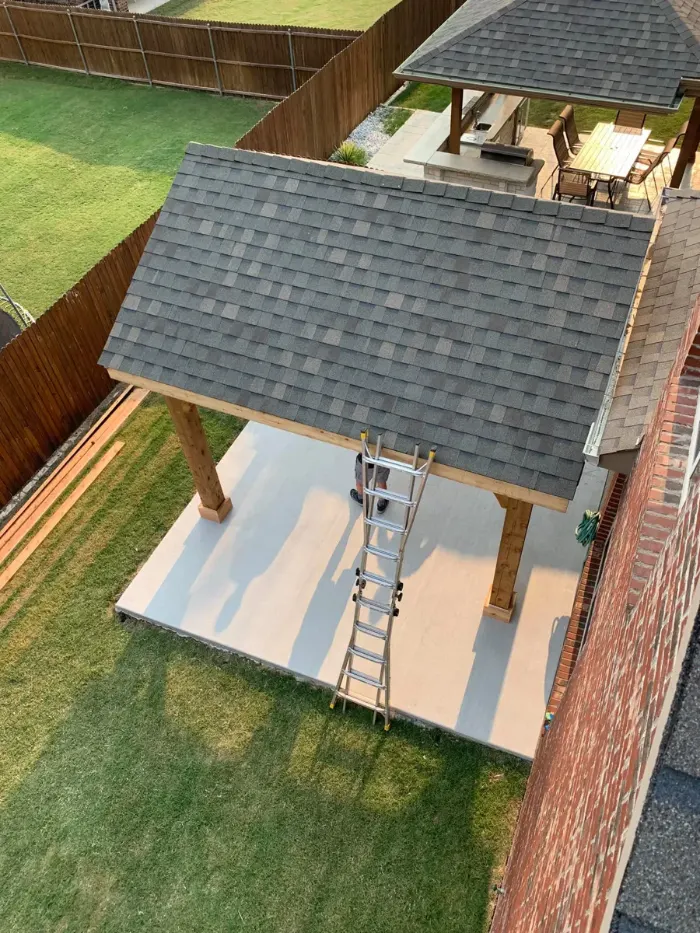
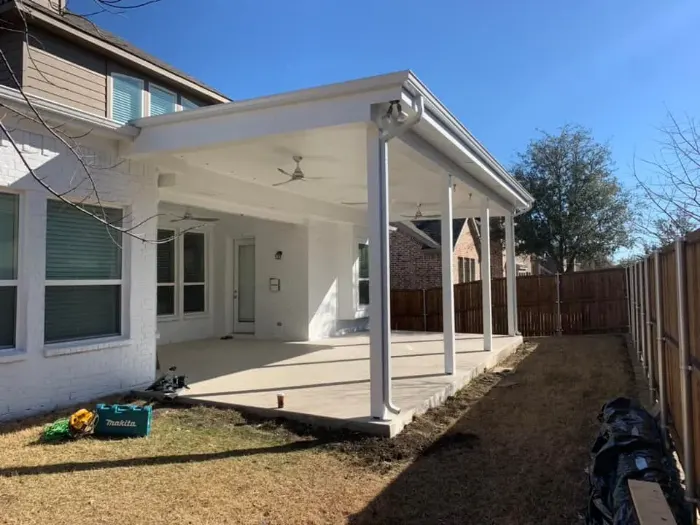
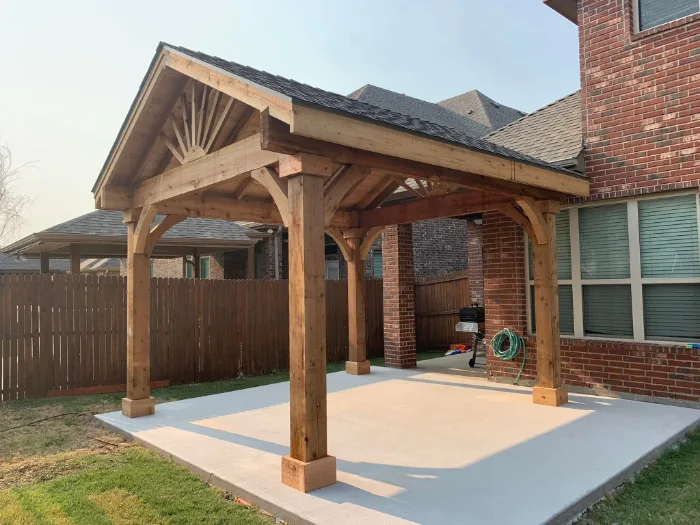
A concrete slab is the most common surface under the covered patios we build, because it gives the cover's posts a solid, level surface and stays easy to clean. Two examples from recent jobs:
- Lancashire Lane, Prosper: a concrete patio under a shingle-roof patio cover on cedar posts, with the shingles matched to the house.
- Lady of the Lake Boulevard, Lewisville: a long concrete patio under a white painted cover with ceiling fans and recessed lights.
If you plan to add a cover later, tell us at the estimate. Planning the slab with a future cover in mind makes the posts easier to place later. See patio covers for cover styles.
Concrete Patio Repair
Not every concrete patio problem means a new patio. These are the problems we see most around DFW:
- Cracks. Thin hairline cracks are normal shrinkage. Cracks that are wide, keep growing, or have one side higher than the other point to movement under the slab.
- Sunken or tilted sections. Usually caused by water washing out the soil under the slab, often right where a downspout empties.
- A slab sloping toward the house. Rain then runs toward the foundation instead of away from it.
- Flaking or scaling surface. The top layer breaks down and leaves a rough, pitted finish.
- A gap between the patio and the house. Lets water down beside the foundation.
We look for the cause before we fix the concrete. Depending on what we find, we repair the damaged area, replace the broken sections, or remove and re-pour the patio, and we deal with the water source, whether that is a downspout that needs an extension or a gutter problem. If patio cracks line up with cracks in your brick or drywall, the house may be moving too; our foundation repair team can check the slab with a free inspection.
Concrete in North Texas Clay and Heat
Our expansive clay soil swells when wet and shrinks during dry spells, and that movement is behind many cracked and sunken patios in the area. Good ground prep, reinforcement and drainage are the best defense. Summer heat is the other challenge: concrete sets quickly on a hot afternoon, so pours are planned around the weather and the finishing crew works fast.
Concrete Patio Pricing, Financing and HOAs
A concrete patio is priced on its size and thickness, how much ground prep the yard needs, access for the concrete truck or pump, and whether old concrete has to come out first. We give you a free written estimate, and financing is available, as low as 0%. In HOA neighborhoods, we follow HOA rules and can provide the layout and details for your approval request.
Want a stone look instead of one slab? See paver and flagstone patios. For shade without a solid roof, see pergolas, and for every patio type we build, visit our patio installation page. Se habla español.
Areas we serve: The Colony, Prosper, Lewisville, Frisco, Little Elm, and all of North Texas.