DFW Hail Season Guide: When Is Hail Season in Texas?
If you have lived in Dallas–Fort Worth for more than one spring, you have probably heard hail on the roof. The question we get most is simple: when is hail season in Texas, and how worried should I be? For North Texas, the short answer is March through June, with April the busiest month. But hail has hit DFW in every month of the year.
This guide uses ten years of hail reports from NOAA's Storm Events Database for Denton, Collin, Dallas and Tarrant counties, the four counties we work in most. It covers when hail hits, the biggest storms in each county, what hail damage to a roof looks like, and what to do after a storm. We update this page after major DFW hailstorms.
When Is Hail Season in Texas?
From 2016 through 2025, NOAA logged about 1,100 reports of hail 1 inch or larger (quarter size, roughly where shingle damage starts) across the four counties. About 88% of them came between March and June.
| Month | Reports of 1-inch or larger hail, 2016–2025 |
|---|---|
| March | 273 |
| April | 303 |
| May | 215 |
| June | 182 |
| September | 51 |
| All other months combined | 76 |
Spring is when warm, humid Gulf air meets cold fronts and dry air coming off West Texas, which builds the tall storms that make big hail. Things quiet down in the heat of July and August, then a smaller second round can show up in September as fronts start coming through again. Winter is not off the table either: February has produced more than 20 reports in ten years, and Trophy Club saw 1.25-inch hail on February 7, 2019.
DFW Hail History by County
These are the largest hailstones NOAA recorded in each county from 2016 to mid-2026. Each report is one spotter, chaser or weather station measurement, so the real number of hail-hit roofs is much higher than the report count.
Denton County had 298 reports of 1-inch or larger hail on 63 different days from 2016 through 2025. The biggest was 5.9-inch hail near Sanger on June 15, 2023, the largest in all four counties over that stretch. Corinth saw 4.25-inch hail on March 26, 2017, Bartonville had 4.25-inch hail on June 11, 2023 and 3.5-inch hail on March 14, 2024, and 2-inch hail fell near Carney on June 2, 2026. We serve The Colony, Lewisville, Flower Mound, Little Elm, Denton, Corinth, Lake Dallas, Hickory Creek, Highland Village, Argyle, Roanoke, Trophy Club and Oak Point.
Collin County had 265 reports on 55 days. Wylie took 5.25-inch hail on April 11, 2016, Allen had 4.5-inch hail on March 24, 2019, and Celina and Plano each saw 3-inch hail, on April 6, 2018 and April 20, 2023. We serve Frisco, Plano, McKinney, Allen, Celina and Prosper.
Dallas County had 157 reports on 55 days. Cedar Hill measured 4-inch hail on June 12, 2023, Coppell had 3-inch hail on June 6, 2018, and 3-inch hail fell in the Lakeview area on April 25, 2026. We serve Dallas, Carrollton, Coppell, Farmers Branch, Addison and Richardson.
Tarrant County had the most, 380 reports on 70 days. Mansfield measured 5-inch hail on June 12, 2023, Keller had 3.25-inch hail on April 28, 2021, and 3-inch hail fell near Azle on April 25, 2026. We serve Southlake, Grapevine and Keller.
What Hail Damage to a Roof Looks Like
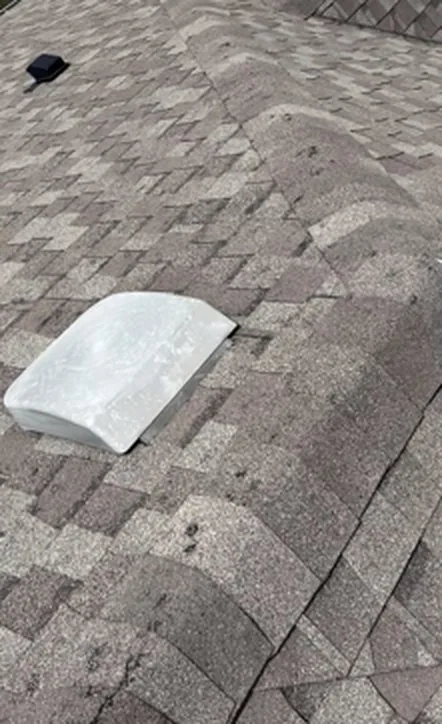
Hail damage to a roof is easy to miss from the ground. On asphalt shingles, look for:
- Bruises: soft, dark spots where a hailstone crushed the shingle mat. They feel spongy when pressed.
- Granule loss: round patches where the gritty surface is knocked off and the black mat shows through.
- Cracked or split shingles: larger hail can crack a shingle outright, especially an older, brittle one.
- Dented metal: dents in vents, turbines, flashing, gutters and downspouts are a good sign the shingles took hits too.
- Granules in the gutters: a pile of granules at the bottom of a downspout after a storm is worth a closer look.
Our post on how to tell if your roof has hail damage has more photos and detail.
What to Check After a Hailstorm
You do not need to climb a ladder. Start from the ground, and stay off the roof:
- Write down the date and time of the storm, and take photos of hail on the ground with something for scale, like a coin.
- Walk the yard and look for dents on the mailbox, AC unit fins, gutters, garage door, patio furniture and your car.
- Check window screens, siding and fence boards for holes or splits on the side the storm came from.
- Look inside for water stains on ceilings, especially near outside walls and in the attic if you can get to it safely.
- If water is coming in, call right away. We offer emergency roof tarping and are open 24 hours.
Then schedule a free inspection. We photograph every slope, show you what we find, and if there is storm damage we meet your adjuster on the roof. Your insurance company decides what is covered. Our guide to the insurance adjuster roof inspection explains how that visit works, and our storm and hail damage repair page covers what we fix.
Getting Ready Before Next Hail Season
The best time to look at your roof is before March. A quick winter inspection gives you a baseline, so it is clear later which damage came from which storm. Clean the gutters, trim branches back from the roof, and fix small problems like a lifted shingle or a loose vent before spring storms find them.
If your roof is near the end of its life, it is worth looking at Class 4 impact-resistant shingles when you replace it. They hold up better to hail than standard shingles, and we install every major brand. Every roof we install also gets a high-profile ridge cap, and most are done in one day.
How We Keep This Guide Updated
When a major hailstorm hits Dallas–Fort Worth, we add it to this page with the date, where it hit and the hail size, and update the date at the top. If you are not sure whether the last storm reached your street, call us and we will come take a look at no cost.
Call (682) 400-6163 to schedule a free roof inspection. Se habla español.